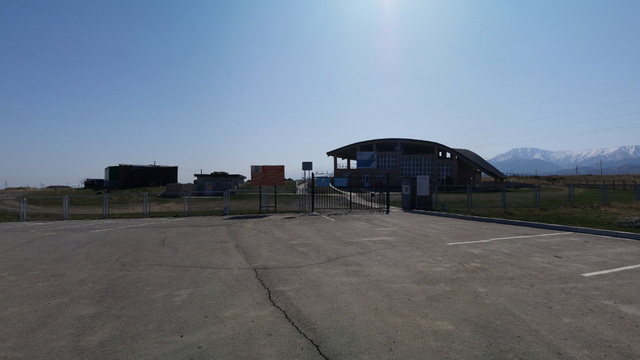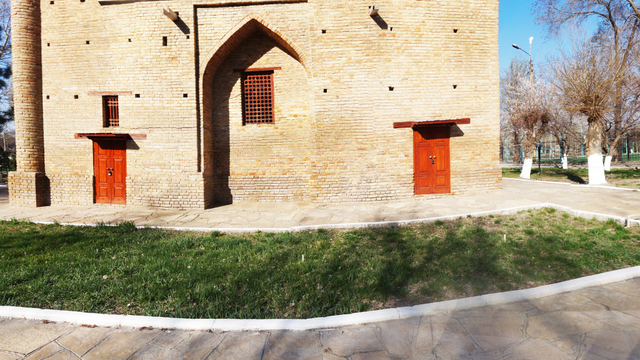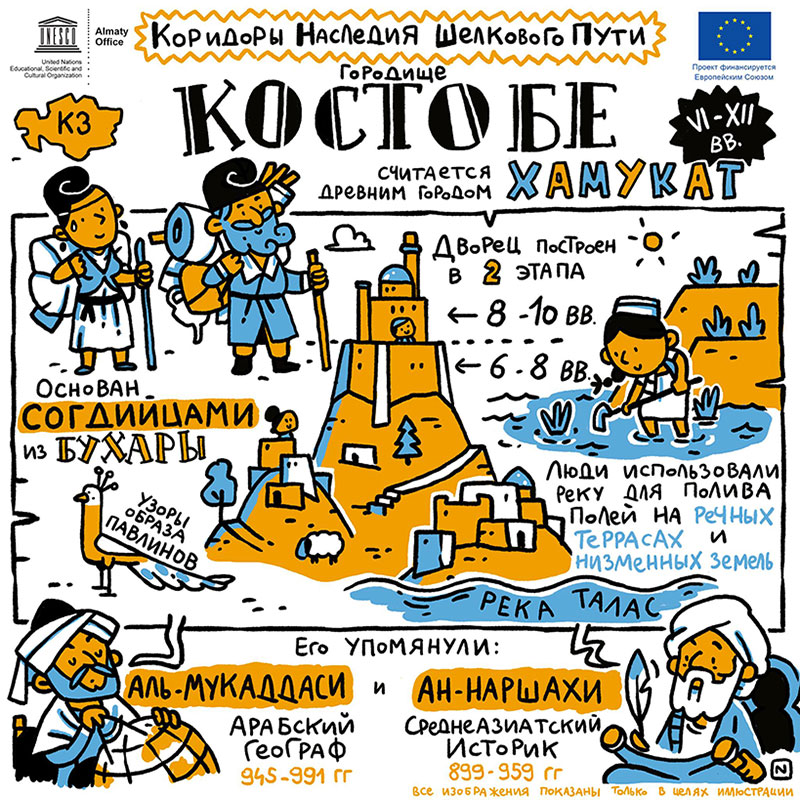
The Kostobe Settlement (6th-12th centuries) is situated on the right bank of the Talas River and consists of separate elevated mounds of varying sizes. Topographically, the settlement resembles the fortified sites of the Chuy Valley: Ak-Beshim, Suyab, and Nevaket.
Kostobe is identified with the ancient city of Dzhamukat (Khamukat). One of the largest ancient cities in the Talas River valley, Dzhamukat was founded in the 6th century by Sogdian settlers from Bukhara. References to it appear in the writings of the 10th-century geographer al-Maqdisi, as well as in the "Tarikh-i Bukhara" ("History of Bukhara") by an-Narshakhi. Dzhamukat was a well-fortified settlement surrounded by walls and moats to protect its residents and travelling merchants. The inhabitants of the city used water from the Talas River to irrigate the fields on the river terraces and lowlands, and ensured its supply, which contributed to the development of the settlement.
The palace was located at the highest point and was constructed in two phases: during the 6th-8th centuries and the 8th-10th centuries. Most of its walls were built of mudbrick, while the ceilings over the large halls, small rooms, and the surrounding corridor were of beam construction. The palace interiors were decorated with carved raw clay -- known as stucco -- alabaster ornaments, and wall paintings. During the second construction phase, a fortress wall was erected in the northern section, and residential and utility rooms were carved into the old wall.
In 2014, the Kostobe Settlement was inscribed on the UNESCO World Heritage List as a component of the serial nomination "Silk Roads: the Routes Network of Chang'an-Tianshan Corridor," jointly submitted by China, Kazakhstan, and Kyrgyzstan.
The corridor represents a 5,000-kilometre section of the Silk Roads. It took shape between the 2nd century BCE and the 1st century CE and remained in use until the 16th century, linking civilisations and facilitating exchange in the fields of trade, religion, science, technological innovation, culture, and the arts.
Illustrations were prepared within the framework of the project "Silk Roads Heritage Corridors in Afghanistan, Central Asia and Iran -- International Dimensions of the European Year of Cultural Heritage," implemented by UNESCO with the financial support of the European Union.
The illustrations are the responsibility of the author and do not reflect the views of the European Union.
Author - Nicolas Journoud
European Union in Kazakhstan
#UNESCOSilkRoadsEU #EUinKZ #EUinKazakhstan