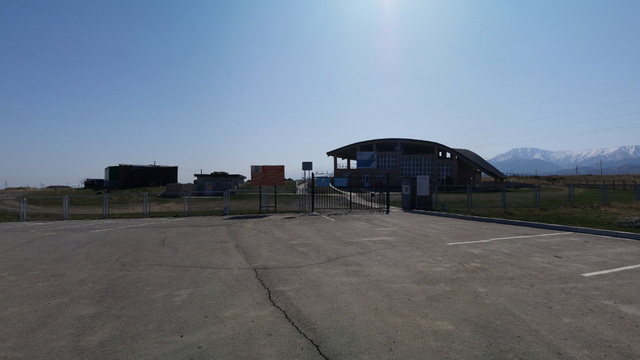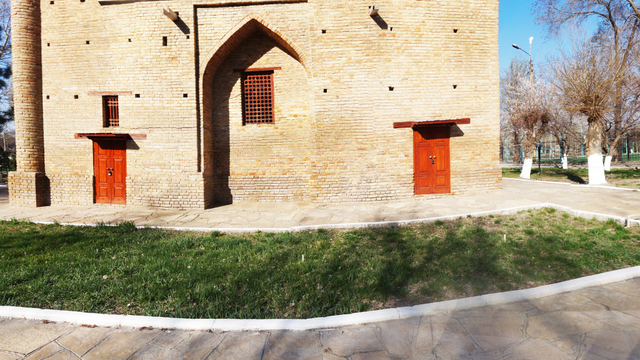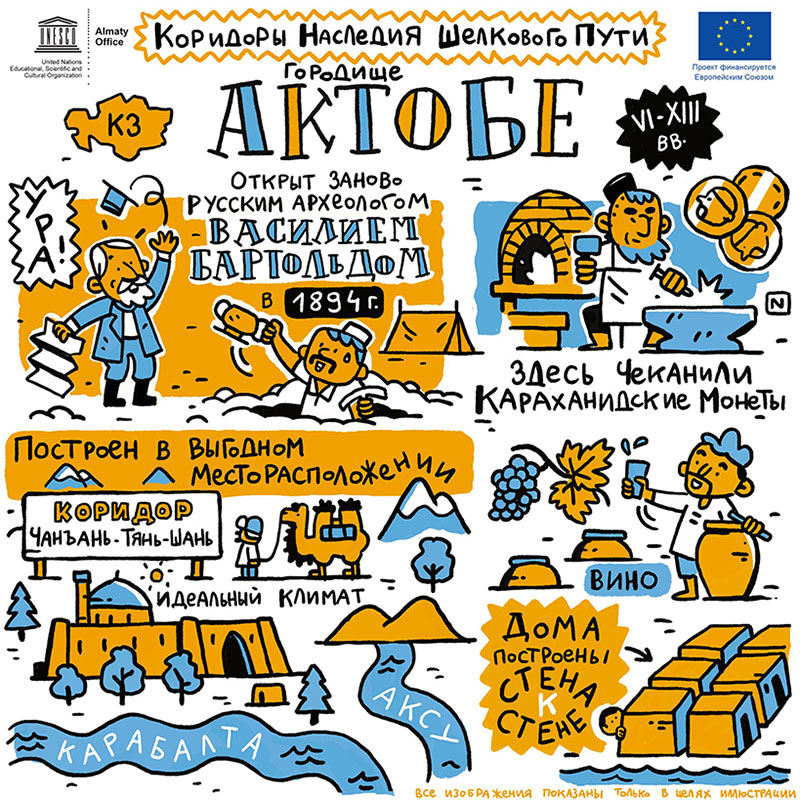
Aktobe was founded in the 6th century CE in a location ideal for urban development, owing to a favourable climate and the proximity of the Aksu and Karabalta rivers. As one of the stations along the Great Silk Road, Aktobe thrived. Indeed, there is evidence that Karakhanid coins were minted here. Furthermore, excavations have yielded artefacts of Sogdian culture, originating from Sogd, Shash, Tokharistan, and Ustrushana.
In 2014, the Aktobe Settlement was inscribed on the UNESCO World Heritage List as a component of the serial nomination "Silk Roads: the Routes Network of Chang'an-Tianshan Corridor," jointly submitted by China, Kazakhstan, and Kyrgyzstan.
The corridor represents a 5,000-kilometre section of the Silk Roads. It took shape between the 2nd century BCE and the 1st century CE and remained in use until the 16th century, linking civilisations and facilitating exchange in the fields of trade, religion, science, technological innovation, culture, and the arts.
Illustrations were prepared within the framework of the project "Silk Roads Heritage Corridors in Afghanistan, Central Asia and Iran -- International Dimensions of the European Year of Cultural Heritage," implemented by UNESCO with the financial support of the European Union.
The illustrations are the responsibility of the author and do not reflect the views of the European Union.
Author - Nicolas Journoud
European Union in Kazakhstan
#UNESCOSilkRoadsEU #EUinKZ #EUinKazakhstan