

"Kazakh National Game – Asyk Atu"

At the 12th session of UNESCO's Intergovernmental Committee for the Safeguarding of Intangible Heritage, the "Kazakh National Game - Asyk Atu" was recognized as UNESCO intangible heritage and included in the list.
The asyk game sharpened children's mental abilities from an early age, teaching accuracy, dexterity, quickness, restraint, resourcefulness, and respect. Let us discuss the current state of this ancient national game and its varieties.
The asyk game is a type of national sport. It is a traditional national game of the Kazakh people. Our people revered asyk bones, as the lifestyle and customs of every nomadic people were closely connected to four types of livestock. This gave rise to numerous terms, concepts, and understandings. Kazakh proverbs and sayings were built around asyks and entered everyday communication. For example, Kazakhs have the kind wish "May your asyk fall on its alsha" - meaning good luck and success. And the folk saying "Don't say it's just a sheep bone, if it fits - hold it as a saka; don't say he's young, if he's wise - consider him an elder" holds deep meaning for those who understand.
The national asyk game has recently received state support and gained its status. Competitions and championships in asyk atu have been held across the country. A federation of asyk games was established, and thoroughly researched game rules were approved. Asyk atu competitions are conducted according to the "Rules of Asyk Games" approved by the former Agency for Sports and Physical Culture of the Republic of Kazakhstan and the Association of National Sports of the Republic of Kazakhstan.
Types and names of asyks
An asyk is a flexible bone in the joint of four types of livestock with a complex function. Asyks of sheep, goats, cows, and camels, regardless of size, have the same shape. Horse asyks are different in shape. Alsha - when the asyk spins and falls on its flat sole. This is given primary importance in the game.
Alsha - when the asyk spins and lands on its flat sole. Special importance is given to this in the game. This is a first-rank asyk.
Taike - when the asyk spins and falls with its sole facing up. This is a second-rank asyk.
Buge - when the asyk spins and lies flat with its convex back facing up. This has third-rank significance.
Shige - when the asyk spins and lies on its back with the concave belly side up. This has fourth-rank significance.
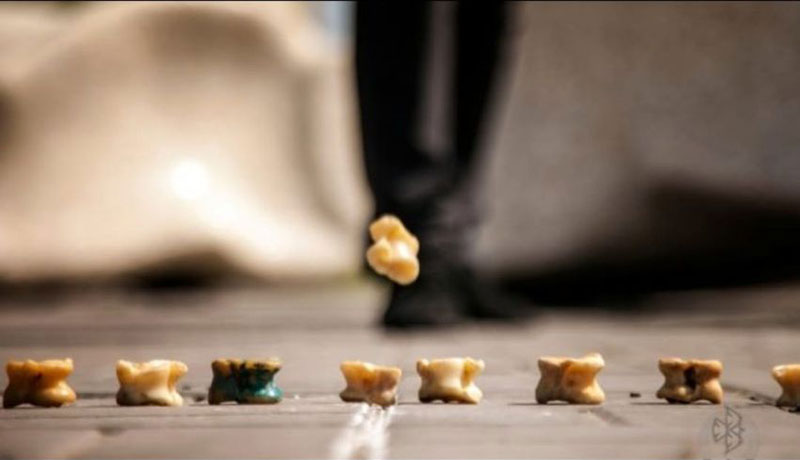
Since ancient times, our ancestors began teaching children the asyk game from an early age. Even before a baby was born, asyks were collected for the future child. The asyk game is not unique to the Kazakh people alone. This game is played by Central Asian peoples, including Uzbeks, Kyrgyz, and Tajiks, to this day. The educational value of asyk games is enormous. They train dexterity, marksmanship, speed, and alertness. Group varieties of asyk games sharpen every child's sense of honor and strengthen their drive to win. The constant sitting and standing, moving while squatting, half-bending knees, contracting and tensing during asyk games strengthen children's bodies and prevent joint diseases.
Before discussing types of asyk games, it is worth noting the Kazakh people's special attitude toward asyks. Our nation did not view the asyk as merely an animal bone. There are ancient beliefs associated with it. For example, "Even if hungry for six years, don't gnaw an asyk" - children were not allowed to eat asyk meat. There is a belief that carrying a wolf's asyk protects from the evil eye and harm. Even in a gunfight, bullets won't hit. People still believe to this day that it will protect in case of unexpected situations.
The Kazakh people also have an ancient belief in fortune-telling with asyks. Our people, whose entire existence was intimately connected with livestock, viewed each way an asyk fell as a sign of one of the four types of livestock. For example, shik represents small livestock - sheep and goats of the patrons Shopan-ata and Shekshek-ata; buk represents cattle of patron Zengi-baba; taike represents horses of patron Kambar-ata; alsha represents camels of patron Oisyl-kara. Based on how the tossed asyk fell, they predicted which type of livestock would be favored in the coming time. And fortune-telling with asyks involved speaking wishes about a traveler's journey, a seeker's search, a hunter's prey, a trap's catch. Of course, if the asyk fell on its alsha, it foretold a good path for the traveler, rich prey for the hunter, and success for the planned endeavor. Therefore, an asyk fallen on its alsha was always highly valued. In short, our nation had numerous beliefs and superstitions connected with asyks.
The asyk game is our national game going back to ancient times, a sport that requires little expense and teaches dexterity. Therefore, its development is important. Organizing numerous asyk game competitions within the country annually serves a purpose: first, introducing youth to sports, and second, reviving a fading national game.