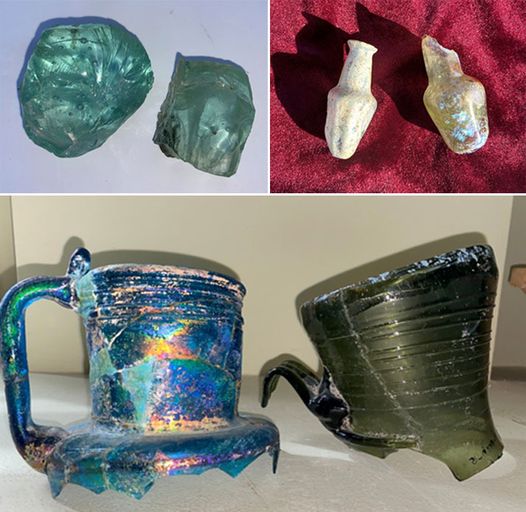
Glassware

Fragments of glass artifacts discovered in ancient Taraz are divided into five groups by functional purpose: household, sanitary-hygienic, perfumery-pharmaceutical, chemical, and window glass. These types of products became widespread in the early medieval period across Central Asia and the Middle East during the development of trade along the Great Silk Road. Ancient and medieval glassmaking centers stretched from the Mediterranean coast — through Western Asia, the Black Sea region, the Caucasus, and Central Asia — to India and China. During the Semirechye archaeological expedition of the Institute of History, Archaeology, and Ethnography of the Academy of Sciences of the Kazakh SSR, collections of glass artifacts were gathered at the Taraz settlement under the leadership of A.N. Bernshtam (1938–1939), T.N. Senigova, and E.I. Ageeva (1961–1962). Based on the stratigraphy of cultural layers, it was determined that the finds date to the 9th–12th centuries. Taraz glassware is described in E.I. Ageeva work — Medieval Glass from Taraz. Following the Traces of Ancient Cultures of Kazakhstan. Nauka Publishing House. Kazakh SSR. Alma-Ata. 1970. pp. 11–14. Medieval glass artifacts and their fragments discovered during archaeological excavations at the Ancient Taraz settlement in 2015–2017 are currently preserved in the collections of the Monuments of Ancient Taraz Reserve Museum. Based on research data from the 9th–12th centuries, it has been established that glass craftsmanship actively developed in Taraz.
Numerous archaeological finds from cultural layers testify to close cultural and political ties with the states of Central Asia and the Near and Middle East during those periods. The migration of Semirechye Sogdians and numerous craftsmen from various countries to the southern regions of Kazakhstan contributed to the development of glassmaking in the Talas Valley. During archaeological excavations in the inner part of the shahristan, archaeologists discovered fragments of glass vessels. All shards of glass artifacts found at the Taraz settlement underwent morphological analysis. They consist of basic structural parts: rim, neck, foot, handle, body, and base. The items were made in various sizes and shapes, manufactured by the blowing method with smooth surfaces and uniform wall thickness. The technical method of the glass-melting furnace maintained a melting temperature not exceeding 1200 degrees. Due to insufficient furnace temperature, the raw material was not fully melted, so the original light color was often not preserved, and bubbles appeared on the surface. Technical methods of industrial and decorative finishing were applied to glassware of various sizes.
The decoration methods demonstrate freedom and diversity of techniques: cold processing elements — the relief method, creating patterns with honeycombs, mold blowing, and molded patterns through the application of glass threads. The glass-blowing tube appeared in the Eastern Mediterranean in the 1st century BC — early 1st century AD. All technical methods of producing glass vessels using a blowing tube share similar forms of basic structural elements. Each craftsman products differ in pattern and quality according to their taste. A distinctive feature of Taraz glass vessels is their conical base. The most widely used production methods were free blowing and mold blowing. Analysis of glass artifact fragments indicates that the residents of Taraz widely used glass vessels in everyday life. Glass artifacts discovered during excavations in Taraz date to the 9th–12th centuries — the period of rule by the Karluk and Karakhanid dynasties in the territory of southeastern Semirechye and Southern Kazakhstan.