

Types of Yurts

At UNESCO headquarters in Paris, the Committee for the Safeguarding of Intangible Cultural Heritage approved the yurt - the finest example of national art - as a "Symbol of Family and Traditional Hospitality." It was also recognized that the yurt is "an inseparable part of the identity of the Kazakh and Kyrgyz peoples." As a result, the joint nomination of two nations, "Traditional Knowledge and Skills in Making Kazakh and Kyrgyz Yurts," was included in the list of humanity's cultural heritage.
Types of Yurts
Yurts are divided into two types: Kazakh and Kalmyk. Kazakh yurts are round with a full dome. Kalmyk yurts have a more conical roof. This is a nomadic dwelling convenient for quick assembly and disassembly during migrations. The nomadic yurt is the first architectural structure in our history. Inside the yurt it is warm in winter and cool in summer. Therefore, both shepherds and tourists use it. The yurt is also convenient during earthquakes as it does not collapse easily. The yurt is a collapsible dwelling suitable for moving from place to place in spring, summer, and autumn. Its walls are constructed from lattice frames called kerege. Kerege comes in two types.
The first is a wide-mesh kerege called "zhelkoz." It is light for transportation but less decorative and, being lightweight, less resistant to wind.
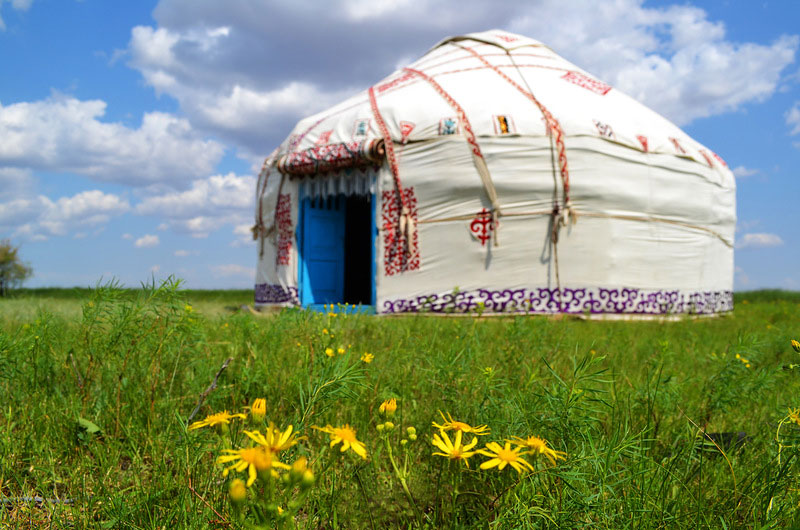
The second type is a narrow-mesh kerege called "torkoz," which is heavier to transport but very resistant to wind. Kerege consists of separate folding sections. Above the kerege, curved poles called uyks are made from strong thin trees to form the dome. The bases of the uyks are tied crosswise to the tops of the spread kerege, and their ends (kalam) are inserted into the holes of the shanyrak.
The shanyrak is the top and window of the yurt dome. The outside of the kerege is covered with reed mats (shi) wound with colorful patterned wool, or plain reed mats. Kerege and uyks are secured with ropes: uykbau, kermebau, baskur, kur, and others. The wooden parts of the yurt are called the "frame" (suyyek). Special felt coverings are attached over the wooden frame: tuyrlyks on the walls, uzuk on top, and tunduk on the roof.
The felt coverings are fastened with ropes. The yurt door is one and a half meters high and 0.8 meters wide. A carved wooden double door called "sykyrlauyik" is installed. Outside the sykyrlauyik, a felt door covered with a woven patterned mat is lowered. In the center of the yurt is a hearth for cooking. On the right side is the bed, behind which a tuskiiz (wall felt carpet) is hung, and a curtain - shymyldyk - is drawn around the bed.
In the place of honor (tor), a stand called zhukayak is placed, upon which trunks, blankets, pillows, and other items are stacked. On the left side, vessels such as kebezhe, kazanayak, saba, and other containers are placed, enclosed by a screen - shyptama. The Kazakh yurt, born from centuries of nomadic life experience, is convenient for protection from the scorching sun and night dampness, rain and frost, and blizzards, while being bright, well-ventilated, and suitable for migration - it can be disassembled and loaded in half an hour, and unloaded and set up in half an hour as well.