

Ancient cowrie artifact

The abundance of cowrie shells found during excavations in the territory of Central Asia and Kazakhstan indicates that this item was one of the traditional ornaments of many peoples of the world. In their time, despite having gilded jewelry, Saka queens dreamed of cowrie shells. Proof of this is that archaeologists found cowrie shells carefully placed in the pits of exotic fruits from the shores of the Indian Ocean in women's burial sites in the Altai and Kazakhstan territories. Since cowrie shells were extremely precious possessions, they were buried together with their owners to be taken to the other world. By the established name, cowrie shells were called shells or snail casings. The shell is formed by certain glands of the snail by extracting lime from water. In ancient times, shells conquered several continents and for centuries governed the fates and economies of peoples. In some countries, they were considered "an object that brings happiness to women." For example, shells were worn as talismans, believing they possessed "magical power that improves women's fertility and protects against infertility, and a power that guards against the evil eye."
Women wore shells as beads, bracelets, and also used them to decorate clothing. Shells are found in excavations dating from the 1st century AD. In ancient times, countries along the Indian Ocean coast used them both as money and as decorative ornaments. Cowrie shells reached many countries of the world through caravan routes — to Central Asia, Europe, and Africa. Countries of the Indian Ocean also used them as money and distributed them as a means of exchange in place of currency. Their value was determined by color and size.
In the world, light-colored cowrie shells 2-3 cm in length, obtained from the Indian Ocean, were considered the highest quality. Tribes inhabiting the shores of warm seas used shells of marine mollusks as a means of exchange. The most widespread was the cowrie — light yellow in color, the size of a button. Cowrie shells strung on thread were used as ornaments and served as money in India, China, on the eastern coast of Africa, and on the islands of Ceylon and the Philippines.
The shells that once enjoyed such enormous prestige among peoples turn out to be tiny creatures living in the shallow waters of the Indian and Pacific Oceans. From the shells of small mollusks, pearls and their variety — inju — were produced. From the accumulation of shells, many sedimentary rocks are formed. As we know, in past centuries people used them for their needs as one of the most precious items brought from abroad, and it is clear that in the future they will remain one of the valuable exhibits that delight and amaze the public.
During excavations of medieval settlements called Taraz, located along the Great Silk Road, numerous ornaments transported from other continents by trade caravans were discovered. Among them, the aforementioned cowrie shell ornament holds a special place. Finds extracted from the settlements are preserved in the collections of the Historical and Cultural Museum-Reserve "Monuments of Ancient Taraz."
The discovered ornamental items show the aspiration of women of that period toward beauty, and also indicate the presence of religious-magical foundations.
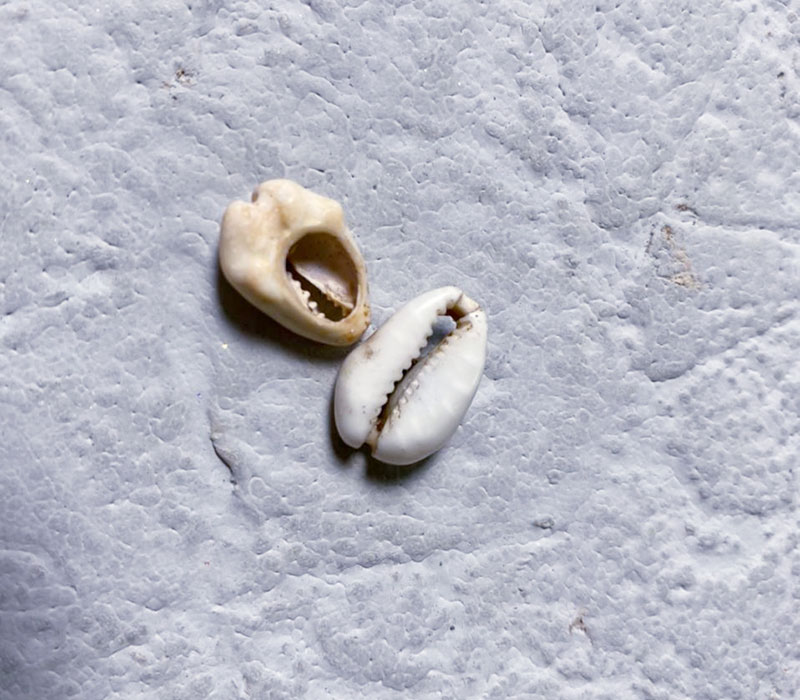
In general, all shells have an elongated shape and are hollow inside. Some species have an elongated opening on one side, while the appearance on the other side resembles lips of human anatomy with slight curvature.
In simple terms, they are usually empty and hollow inside, meaning they should be understood as former "houses" of some deceased sea animals. However, it is known that snails are also found in forested areas and rivers. It is not surprising that we might wonder: "Then can we collect them on land too?" Our cowrie shells were formed by a marine animal called a "snail" (soft-bodied organisms). They live in shields (shells) that protect their soft skin.
A shell can be called a "skeleton of a snail" or "part of an animal," meaning the snail is attached to it with its body. Soft-bodied organisms never leave their "homes."
Shells of porcelain or light yellow color are known by the nickname "snake head." All shells have a shiny appearance resembling light porcelain.