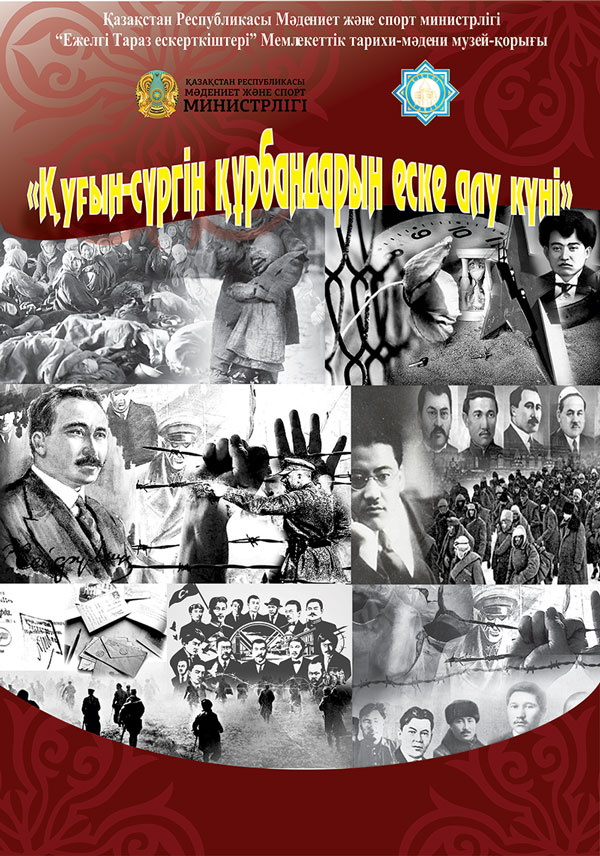
"Under the Banner of Alash, We Shall Not Fade While the Sun Still Shines!"

In the early 20th century — a day of remembrance for victims of political repressions that brought suffering to many people.
This tragic day in history has been commemorated since 1997.
Repressions in the USSR republics began in 1928. In Kazakhstan, the Alash movement activists were arrested first. They were charged with "nationalism." As a result, Alikhan Bukeikhanov, Zhakip Akbayev, Alimkhan Yermekov, Sanzhar Asfendiyarov, Akhmet Baitursynov, Beimbet Mailin, Magzhan Zhumabayev, Abdulla Rozybakiyev, Turar Ryskulov, Mukhamedzhan Tynyshbayev, Ilyas Zhansugurov, and other intellectuals were sentenced to death.
According to official data, more than 103 thousand people were subjected to repressions in Kazakhstan. More than 25 thousand people were sentenced to death. Among them were scientists, cultural and political figures, and doctors.
During the years of repression, 800 thousand Germans, 102 thousand Poles, 19 thousand Koreans, and 507 thousand representatives of the North Caucasus peoples were deported to Kazakhstan. Crimean Tatars, Turks, Greeks, Kalmyks, and representatives of other nations were also forcibly resettled on Kazakh land. In total, 1 million 500 thousand people were deported to our country.
As a result of the harsh policy of identifying "enemies of the people," not only the repressed themselves suffered, but also their relatives. Special camps were created for them in Kazakhstan: ALZHIR (Akmola Camp for Wives of Traitors to the Motherland), Karlag (Karaganda Corrective Labor Camp of the NKVD), and Steplag (camp for political prisoners).
The largest camp was ALZHIR, where wives of "traitors to the Motherland" were held. The institution that ruined many destinies was established by order of the NKVD of the USSR on August 15, 1937, in the settlement of Revolution (Malinovka) near the city of Akmola. The ALZHIR camp occupied an area of 30 hectares. It had several divisions in the Karaganda and Akmola regions.
The work of rehabilitating victims of mass political repressions and restoring the rights of illegally persecuted citizens has not stopped in our country. After Kazakhstan gained independence, on April 14, 1993, the law "On Rehabilitation of Victims of Mass Political Repressions" was adopted.
In 1997, by decree of President of Kazakhstan Nursultan Nazarbayev, May 31 was declared the Day of Remembrance of Victims of Political Repressions.
Additionally, May 31 is a day of remembrance for famine victims. Famine struck the Kazakh steppe twice: in 1921-1922 and 1932-1933.
After the end of the Civil War, the peoples of the Soviet Union faced another severe trial. In 1921-1922, a prolonged snowless winter was followed by a rainless summer. The absence of snow in winter and rain in spring and summer led to severe drought, resulting in famine.
In the Ural, Orenburg, Kostanay, Bukeev, and Aktobe provinces, crops failed due to drought. Pastures and hayfields in nomadic and semi-nomadic areas engaged in cattle breeding were completely burned. Additionally, the prolonged harsh winter of 1920-1921 led to massive livestock deaths in the Torgai district. As a result, most of Kazakhstan was gripped by famine.
According to some data, by the autumn of 1921, more than 20 million people in the Soviet Union were suffering from hunger.
In March-April 1922, the famine in Kazakhstan sharply worsened.
In the report of KazCEC Chairman Seitkali Mendeshev at the III session of KazCEC on July 8, 1922, it was stated that according to incomplete data obtained in the spring of that year, the number of starving people on Kazakh land had reached 2 million 832 thousand. At the end of 1920, the population was 4 million 781 thousand 263 people. Of these, 50.3% were Kazakhs, 31.2% were Russians, and 14.4% were Ukrainians.
In 2012, at the grand opening of the monument "Tribute to the Victims of Famine" in Astana, Nursultan Nazarbayev noted that the famine of 1932-1933 on the territory of the Soviet Union was one of the most tragic periods in human history.
"In those times, the devastating famine that engulfed not only Kazakhstan but also Russia, Ukraine, and Belarus claimed the lives of 7 million people. The Kazakh people were among those who suffered most from this man-made disaster," said Elbasy.
According to historical data, in 1932-1933, at least 2 million Kazakhs died of starvation. And 200 thousand Kazakhs emigrated to other countries.
"Under the banner of Alash, as long as the Sun does not fade, we shall not fade either!"